Adrok have applied their sub-surface heat detection methods in New Zealand (the Wairakei Geothermal Field near the Taupo Volcanic Zone) and the UK (Weardale, NE England).
How do the UK measurements compare to the New Zealand measurements?
Adrok’s ADR surveys show the Wairakei (NZ) site is much hotter and has a far stronger, continuous thermal signature than the Weardale / NE England sites. Adrok report ~125 °C/km for Wairakei versus ~38 °C/km for Weardale, and their Energy-Gamma (E-Gamma) plots show strong, continuous thermal impact from ~500–2000 m at Wairakei but only discrete “hot spots” at ~400–700 m and ~1600 and ~1800m in Weardale.
New Zealand v UK comparison Geothermal Infographic
Key measured / reported numbers
- Adrok geothermal gradient (Wairakei): ~125 °C/km. Wairakei vs Weardale states this value and shows consistent, large thermal anomalies through 500–2000 m in the Wairakei scans.
- Adrok geothermal gradient (Weardale / NE England): ~38 °C/km. The E-Gamma plots for Weardale show thermal impact targets concentrated at ~400–700 m, then relatively uneventful deeper down to 2000 m (other than at ~1600 and ~1800m).
- Drill/ground truth correlation: the Eastgate (Weardale) borehole drilling encountered a hot saline influx at ~411 m, which Adrok say correlates with their ADR thermal target. Adrok also cite Science Central borehole temps of >60 °C at ~1,350 m as consistent with ADR troughs (refer to Adrok case study 5.08) .
- Adrok drill-temperature examples: figure shows drillhole temperature points (one set near 31.3 °C and another near 256.9 °C) in their UK vs NZ comparison slide — supporting the very large thermal contrast they detect between Wairakei and Weardale. (These are Adrok values and should be interpreted in context with the reports and local well data.)
What that means (interpreting the comparison)
- Magnitude: Wairakei is an active high-enthalpy volcanic/geothermal system (shallow magmatic/hydrothermal heat). Adrok’s ADR shows a strong, persistent thermal signal and much steeper gradient (125 °C/km) — consistent with known Wairakei reservoir temperatures and use for power generation. Weardale shows modest but useful elevated gradient (38 °C/km) relative to UK background; however it is much lower than Wairakei and the thermal targets are more discrete (fracture-hosted or localised hot zones).
- Depth & usability: In Wairakei equivalent high temperatures are present at much shallower depths (often <1 km in productive zones). In Weardale, useful temperatures are present at a few hundred metres to ~1–1.5 km for low-enthalpy uses (Adrok cites >60 °C at 1,350 m in Newcastle/Science Central), and fracture inflows (e.g. 411 m at Eastgate) can produce local higher-temperature fluids.
- Local geology matters. ADR signals depend on dielectric and harmonic responses of rocks and fluids; Weardale’s hot signals are attributed to fractures, saline inflows and granite-related heat, while Wairakei’s signal is controlled by volcanic/hydrothermal system geometry — so direct comparison is valid for “how strong/continuous the thermal proxy signal is” but must be integrated with borehole and geological data for a full resource picture...
- Depth–temperature comparison plot using the Adrok-reported geothermal gradients for the two sites:
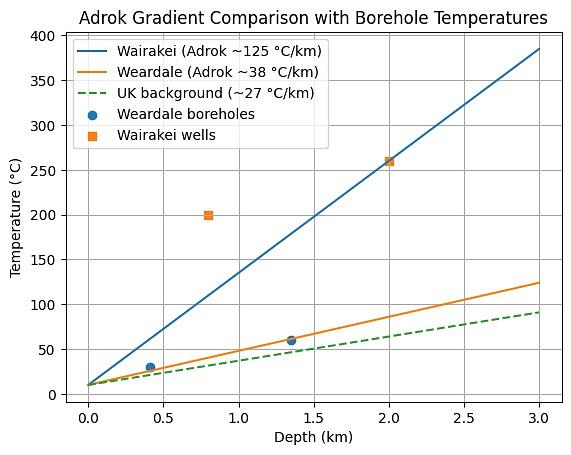
What this plot demonstrates
1. Wairakei (New Zealand)
- The measured well temperatures (≈200 °C at ~0.8 km; ≈260 °C at ~2 km) sit very close to the Adrok ~125 °C/km line.
- This shows good first-order consistency between:
- Adrok’s strong, continuous ADR thermal signal, and
- The known high-enthalpy geothermal reservoir exploited for electricity generation.
- Interpretation: ADR is detecting a regionally pervasive thermal system, not just isolated anomalies.
2. Weardale / NE England (also refer to case study 5.08)
- Borehole points (Eastgate ~30 °C at 411 m; Science Central ~60 °C at ~1.35 km) lie:
- Above the UK background gradient (~27 °C/km), and
- Close to the Adrok ~38 °C/km line.
- This supports Adrok’s claim that Weardale is thermally anomalous within the UK, but:
- The anomaly is moderate, and
- Temperatures increase more slowly with depth than in volcanic systems.
3. Key contrast (the takeaway)
- At ~1 km depth:
- Wairakei: ~135–200 °C
- Weardale: ~45–60 °C
- Wairakei reaches power-generation temperatures at shallow depth.
- Weardale reaches direct-heat temperatures at similar depths, with power-grade temperatures only conceivable at much greater depths and likely requiring engineered systems (EGS).
Adrok’s UK measurements:
- Detect real, measurable heat anomalies that correlate with borehole data.
- Represent a ~40% uplift over UK background gradients, validating Weardale as one of the warmer UK provinces.
However, compared to New Zealand:
- The UK signal is an order of magnitude weaker in geothermal intensity.
- ADR responses in the UK reflect localized fracture- and granite-related heat, whereas NZ responses reflect a large, continuous volcanic–hydrothermal system.
Adrok’s UK (Weardale/Eastgate/Science Central ) measurements show moderate, localised geothermal potential (gradients ~38 °C/km, discrete hot spots such as at 411 m), whereas their New Zealand (Wairakei) scans show very high, continuous thermal impact (reported ~125 °C/km and drill temperatures consistent with high-enthalpy reservoir conditions). The contrast aligns with the geological setting (active volcanic field vs. cool continental crust with fracture/granite-hosted anomalies).